Beneficial effects of vascular endothelial growth factor B gene transfer in the aged heart
Abstract:
Aims
Members of the VEGF family are crucial modulators of vascular and neural function. While VEGFA signalling has been shown to mitigate several aging-related cardiac phenotypes and prolong survival in aged mice, the role of VEGFB in cardiac aging remains underexplored. In this study, we identify a significant decline in Vegfb expression, particularly of its soluble isoform Vegfb186, in aged mouse and human hearts. To assess the therapeutic potential of VEGFB in aging-associated cardiac pathologies, we used AAV9-mediated gene transfer to overexpress Vegfb186 in 18-month-old male C57Bl/6J mice.
Methods and results
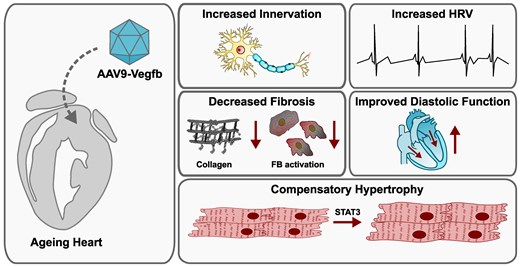
VEGFB is known to exhibit vascular and neuroprotective effects that we assessed in the ageing heart. In the aged heart, doses of Vegfb186 overexpression that had only a modest effect on the vascular endothelium prevented age-induced diastolic dysfunction and fibrosis. Vegfb186 treatment additionally restored sympathetic and sensory nerve fibre density and increased heart rate variability. Although Vegfb186 overexpression induced cardiac hypertrophy, our findings indicated that this hypertrophy was compensatory rather than pathological as Vegfb186 overexpression corrected the elevated cardiomyocyte length-to-width ratio observed in aged hearts, a metric typically indicative of pathological remodelling. Cardiac single-nucleus RNA sequencing of the hearts and in vitro analysis of the cardiomyocytes indicated up-regulation of the STAT3 signal transduction pathway as a potential contributor of VEGFB-induced cardiac hypertrophy.
Conclusion
Our findings demonstrate that Vegfb186 overexpression partially reverses age-related cardiac pathologies such as diastolic dysfunction and fibrosis. This work highlights VEGFB as a potential therapeutic target for combating cardiac aging and its associated dysfunctions.
Read the full publication: Beneficial effects of vascular endothelial growth factor B gene transfer in the aged heart | Cardiovascular Research | Oxford Academic
Originally published August 2025. Cardiovascular Research.